One shoot day, thirty days of posts
How I plan a single afternoon of filming so a small business never has to think about content again that month.
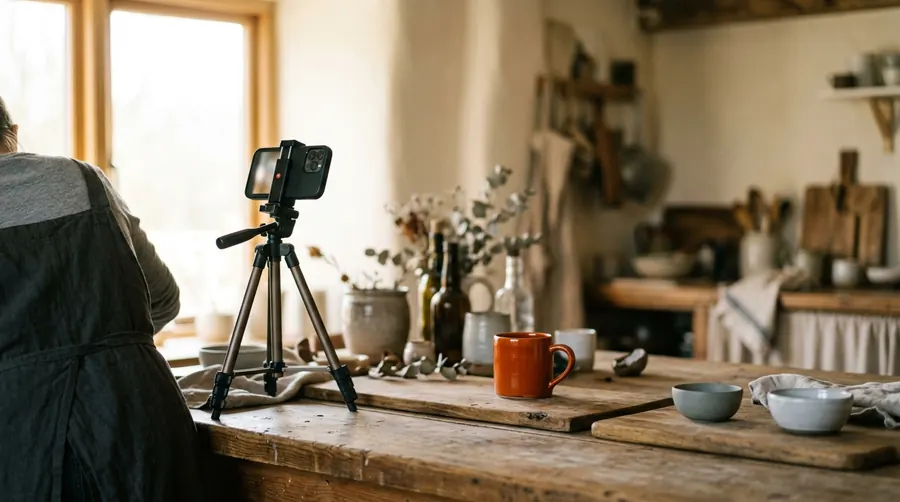
The reason most small businesses go quiet on social media isn’t laziness, and it isn’t a shortage of things to say. It’s that “post something today” is a terrible task. It arrives every single day, in the middle of running a business, demanding an idea, a video, a caption, and the nerve to publish — all at once, forever.
So I don’t ask owners to post. I ask them for one afternoon a month. Three hours of filming, planned properly, turns into thirty days of content — and the planning is the part that matters, because a shoot day without a list is just three hours of wandering around the shop with a phone.
Here’s the exact way I run it.
Before the shoot: the list is the work
I sit down with the owner for half an hour and build three short lists. No camera involved.
Questions customers actually ask. Not what you wish they asked — what they say on the phone, in DMs, at the counter. “How much does it cost?” “How long does it take?” “Do I need an appointment?” “What if it rains?” Every one of these is a video, because a question one customer asked out loud is a question fifty others typed into Google. Ten of these is the backbone of the month.
Moments worth seeing. Every business has process that looks like magic to outsiders and feels like nothing to the people doing it. The fence going up. The dough being folded. The before-and-after of a detail job. Owners always undervalue this footage because it’s their everyday; it’s also the single most-watched kind of content a local business makes.
One offer and one story. Whatever you want more of this month — the seasonal special, the service with open capacity — plus one human thing: why you started, a customer you helped, the person behind the counter people see every week. One each. A feed that’s all offers is an infomercial; a feed that’s all heart never books a job.
Those three lists become a shot list of about fifteen items, in filming order, so the afternoon runs like a checklist instead of an improvisation.
The shoot itself: three hours, a phone, and a window
No crew, no lights, no studio. A recent phone, a $30 tripod, and the brightest window in the building beat a professional setup nobody schedules twice.
The afternoon splits into three blocks:
Hour one — talking. The owner (or whoever’s most comfortable) answers the customer questions to camera, one at a time, in plain speech. No script — scripts make people sound like hostages. I ask the question from behind the camera and they answer me, not the lens. Each answer is thirty to ninety seconds. If a take goes wrong, we just say it again; nothing is precious.
Hour two — hands. We film the process list: wide shot of the work, close shot of the hands, a slow pan of the finished thing. Ten to twenty seconds per shot, three shots per process. This footage gets used everywhere — under voiceovers, behind text, as the b-roll that makes talking clips watchable.
Hour three — the shop and the people. The storefront, the van, the team laughing at something, the coffee machine, the dog that comes on Tuesdays. Texture. This is the footage that makes a feed feel like a place rather than a brochure.
After the shoot: one afternoon becomes thirty posts
Editing is where the multiplication happens, and it’s arithmetic, not magic:
- Ten question answers → ten talking videos, each one its own post.
- Five processes × before/during/after → five transformation posts, the most shareable thing a trade business makes.
- The offer, filmed once → three versions with different opening lines, because you’ll want to run it more than once.
- The story piece → one anchor post, usually the best performer of the month.
- Texture footage → stories and filler between the main posts, plus covers and photos pulled as stills.
That’s roughly thirty pieces, and I write the captions the same week while the footage is fresh — captions written on posting day always come out as “Happy Monday! ☀️” because the person writing them is busy running a business.
Then everything gets scheduled in one sitting. The whole month, queued. The owner’s only job for the next thirty days is replying to the comments — which is the part only they can do anyway.
Why this works when “post more” never does
Because it turns a daily creative demand into a monthly appointment. Appointments get kept. And because batching respects the actual economics of an owner’s attention: the same brain that can’t produce one good idea at 7am on a Tuesday can produce fifteen in a planned afternoon.
If you take nothing else from this: make the three lists. Even if you never hire anyone, an afternoon with those lists and a phone tripod will produce more usable content than the last six months of meaning to post something.
 Text 516-707-8820